
Precision Engineering Cordyceps militaris: Oleic Acid Triggers, Blue Light Cascades, and the End of Strain Degeneration
Cordycepin yields up to 34x higher, blue-light gene cascades, and monokaryon pairing — inside the quiet revolution in Cordyceps militaris biotechnology.
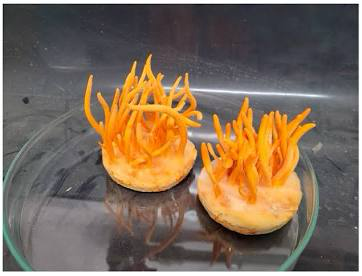
While wild Ophiocordyceps sinensis remains one of the world's most expensive natural commodities, its cultivate-able cousin, Cordyceps militaris, has driven a quiet revolution in fungal biotechnology. Once grown simply on jars of cooked rice or silkworm pupae, C. militaris is now at the center of precision mycological engineering aimed at maximizing active compounds like cordycepin, adenosine, and pentostatin.
What Even Hardcore Cordyceps Fans Might Not Know
The Oleic Acid Trigger: While cultivators often focus on protein-to-carbohydrate ratios, recent substrate research revealed that fatty acid profile — specifically oleic acid — acts as a direct biochemical switch for cordycepin synthesis. Growing C. militaris on substrates enriched with specific insect fats (such as Allomyrina dichotoma beetle pupae) or supplementation with targeted plant oils upregulates the expression of the cns1 and cns2 gene cluster, skyrocketing cordycepin yields up to 34 times higher than standard silkworm meal.
Light-Driven Gene Cascades: The iconic vibrant orange color of C. militaris isn't just aesthetic; it is a metabolic response. Blue LED wavelengths (~435–450 nm) trigger the photoreceptor gene CmWC-1 (White Collar-1), stimulating both carotenoid biosynthesis and cordycepin production. Conversely, exposing fruiting bodies to red light can actually suppress cordycepin accumulation.
The Degeneration Paradox: Unlike oyster or button mushrooms, C. militaris suffers from rapid strain degeneration when subcultured on agar. Because it is heterothallic (requiring two compatible mating-type genes, MAT1-1 and MAT1-2), repeated serial transfers often lead to nuclear imbalance, causing the culture to permanently lose its ability to produce fruiting body primordia within just a few generations.
Current and Next-Generation Cultivation Techniques
1. Wavelength-Targeted LED "Recipes"
Grow rooms are moving away from fluorescent lighting toward multi-stage light schedules. Cultivators use darkness for initial mycelial run, followed by high-flux blue light to trigger primordia, and final spectrum mixes to optimize biomass without causing photo-bleaching.
2. Liquid Submerged Fermentation (LSF)
For pharmaceutical applications, waiting 30–50 days for solid-state fruiting bodies on grain is becoming obsolete. Submerged liquid cultures using low-cost nitrogen sources (like corn steep liquor hydrolysate) can yield high concentrations of cordycepin and extracellular polysaccharides in a fraction of the time inside bioreactors.
3. Mating-Type Monokaryon Pairing
To eliminate culture degeneration, modern laboratories single-spore isolate monokaryotic strains, sequence their mating loci, and store compatible pairs at -80°C. They are only combined right before inoculation to ensure maximum vigor and consistent fruiting.
The Horizon: Gene Editing & Metabolic Modeling
Future research is moving toward genome-scale metabolic models (GSMMs) to map the exact metabolic flux of C. militaris. By combining CRISPR-Cas9 gene editing with precise light-and-substrate inputs, researchers aim to engineer strains that produce pharmaceutical-grade cordycepin without relying on insect-derived substrates or unpredictable fruiting cycles.
Written by Robert Michael Watson, founder of Organically Gourmet. Research summaries are educational and are not medical advice.
Discussion
Comments are screened for spam and reviewed by the Organically Gourmet team before they appear.