
Monokaryon Isolation and Pairing: The Cure for Cordyceps militaris Strain Degeneration
A full bench protocol for isolating single-spore monokaryons from a mature Cordyceps militaris fruiting body, determining mating types, and re-pairing them into fresh, generation-zero dikaryons.
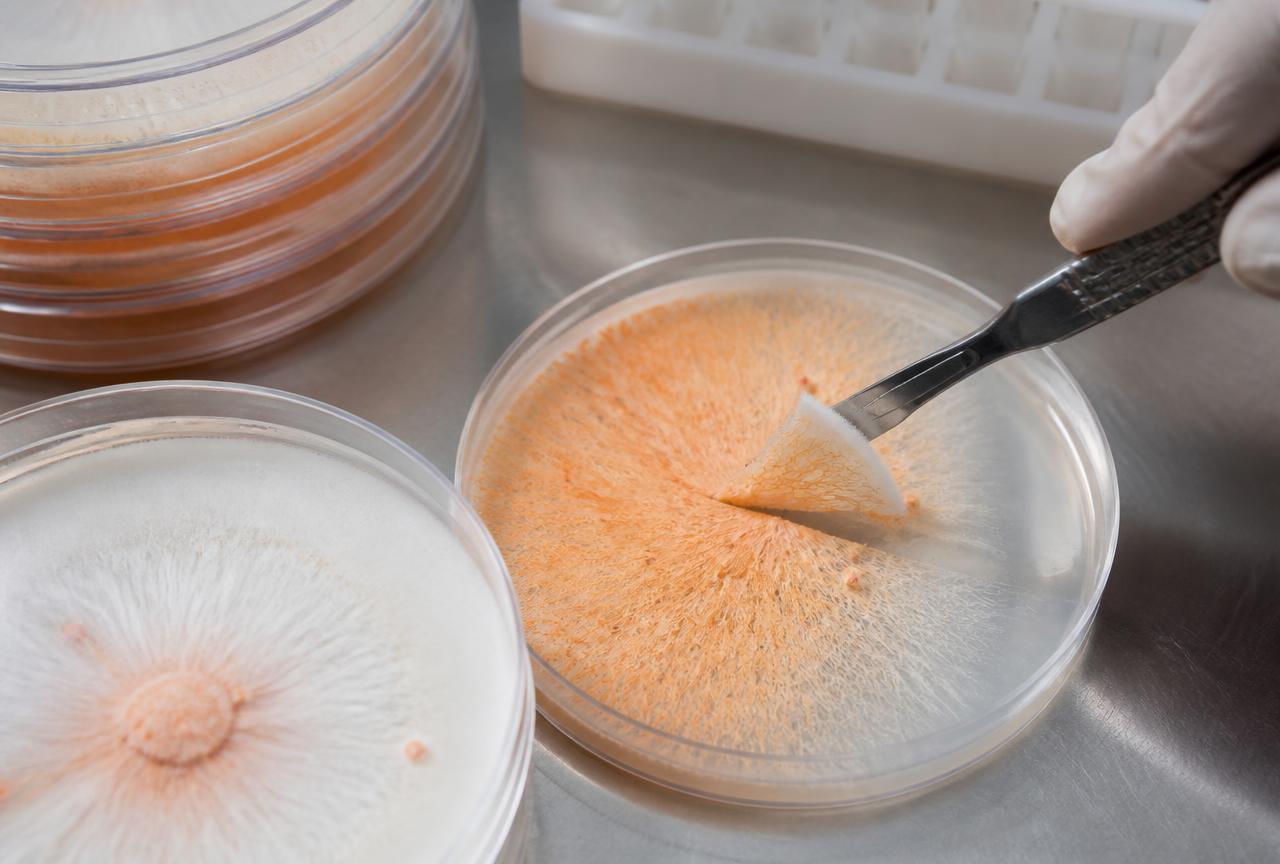
Isolating and pairing monokaryons is the industry standard for preventing strain degeneration in Cordyceps militaris. Because C. militaris is a heterothallic fungus, a single ascospore carries only one mating-type allele (MAT1-1-1 or MAT1-2-1). On its own, a monokaryotic mycelium usually grows slowly and cannot form fruiting bodies. Only when two compatible single-spore isolates fuse does a vigorous dikaryon form.
Here is the step-by-step protocol to isolate monokaryons from a mature fruiting body and re-combine them to establish fresh, fruiting-capable culture stock.
Phase 1: Ascospore Discharge & Collection
1. Select a Prime Donor: Choose a fresh, fully mature C. militaris fruiting body with well-developed perithecia (the tiny, pimple-like bumps on the upper stalk).
2. Setup Spore Capture: Inside a laminar flow hood, sanitize a sterile glass Petri dish or custom spore-collection chamber. Suspend a 1–2 cm piece of the fruiting body cap beneath the inside lid of the Petri dish using sterile petroleum jelly or high-vacuum grease so it hangs roughly 5–10 mm above standard Potato Dextrose Agar (PDA).
3. Trigger Discharge: Place the plate in the dark at 20°C for 4 to 12 hours. The perithecia will naturally shoot multi-celled ascospores downward onto the agar surface.
4. Remove the Source: Remove the hanging fruiting body piece as soon as a faint white spore print appears to prevent over-densification.
Phase 2: Dilution & Single-Spore Isolation
1. Prepare Dilution: Flush the spore print with 1 mL of sterile distilled water containing a single drop of Tween 80 (a surfactant that breaks up clumping). Gently scrape the surface with a sterile inoculating loop.
2. Serial Dilution: Transfer 100 µL into a series of test tubes filled with 900 µL sterile water to create 10^-1 through 10^-4 dilutions.
3. Plating: Spread 50 µL of the 10^-3 and 10^-4 dilutions across low-nutrient agar plates (such as 1/4-strength PDA or Water Agar). Low nutrient levels discourage rapid mycelial growth, keeping colonies separated.
4. Incubation: Incubate plates at 20–22°C. Spores typically germinate within 12–24 hours under a microscope.
5. Colony Picking: Under a stereo microscope or hand lens, identify isolated single germinating spores. Using a micro-scalpel or fine inoculating needle, excise a tiny agar block containing just one single germinated spore and transfer it to its own individual PDA tube or dish. Label these isolates sequentially (S1, S2, S3 … S20).
Phase 3: Mating-Type Determination
You must identify which isolates belong to MAT1-1 and which to MAT1-2. There are two methods to do this:
Method A: PCR Testing (Fast & Precise)
1. Extract DNA from each single-spore culture.
2. Run PCR using specific primers for the MAT1-1-1 and MAT1-2-1 gene loci.
3. Gel electrophoresis will show distinct band lengths identifying the mating type of each sample.
Method B: Dual-Culture Pairing Assay (Classical Method)
If molecular testing isn't available, run a grid confrontation assay:
1. In a single Petri dish, place two agar plugs roughly 1.5–2 cm apart: one plug from isolate S1 and one from isolate Sx.
2. Inoculate all pairing combinations across multiple plates (e.g., S1 × S2, S1 × S3, etc.).
3. Incubate in the dark at 20°C for 5–7 days.
Interpreting Results:
Incompatible (Same Mating Type): The two mycelial fronts will grow toward each other, slow down, and form a distinct barrier line or aerial "ridge" of rejection.
Compatible (Opposite Mating Types): The mycelia will merge smoothly without a line of inhibition. Within 3–5 days after contact, the fused zone usually shows increased growth vigor, dense white mycelium, and early pigment formation.
Phase 4: Storage & Maintenance
1. Freeze Monokaryons: Store compatible pairs separately as monokaryotic master cultures in 15% glycerol at -80°C or liquid nitrogen. Monokaryons do not lose their genetic potential over time because they are not undergoing nuclear division competition.
2. Create Fresh Batches on Demand: Whenever you need to grow a production run, revive one stored MAT1-1 strain and one MAT1-2 strain, combine them on a single dish, and allow them to fuse. The newly formed dikaryon will behave like a wild, generation-zero culture with maximum fruiting power.
Written by Robert Michael Watson, founder of Organically Gourmet. Research summaries are educational and are not medical advice.
Discussion
Comments are screened for spam and reviewed by the Organically Gourmet team before they appear.